15 March 2014


Commanderie de la Romagne
Commanderie de la Romagne which was part of the Grand Priory of Champagne. It was originally a Templar fortification became property of the Order of Malta in the early 14th century. In 1595 after the Battle of Fontaine Francais, King Henry IV installed his camp here. He was welcomed by the Grand Prior of Champagne, Philibert de Foissy. St. John's Gate, the large archway, is part of the building where the drawbridge was once stored. It has been restored to host guests in period style rooms. For more information visit http://www.romagne.com/home.htm


12 March 2014
Church of St. Andre in Luz-Saint Sauveur
The village of Luz-Saint-Sauveur in the Haute Pyrenees. The Church of St. Andre was built in the late 11th century by the St. Andre family and dedicated to the apostle of the same name.
 In the 14th century the family gave the Church to the knights of St. John who used it to provide sanctuary to pilgrims on the Camino of St. James. The knights built the circular rampart to protect the townspeople from the "bandits Aragonais" who roamed the region. The tower was used as a munitions depot.


19 October 2013
Commandery de Bures, France
The Commandery de Bures was another sub-priory of the Hospitaller Grand Priory of Champagne which was originally a property of the knights Templar. It was in the position of the Order of St. John from 1317 until it was confiscated under the French Revolution. In 1958 the owner of the property was searching for Templar treasure by using explosives and destroyed much of the structure. In 2006 the current owner began restoration efforts. The red roof building in the background is the chapel of the commandery and now the parish church. The first picture is a guard room of the Hospitallers. For additional pictures of the site visit, http://www.christaldesaintmarc.com/la-commanderie-des-templiers-de-bure-c883337


Commandery d'Epailly, France
The Commandery of Epailly was originally a property of the knights Templar but was given to the Order of St. John after the Templars were suppressed. It was fortified by the Hospitallers during the 14th and 15th Centuries. It was part of the Grand Priory of Champagne. The Hospitallers first Grand Prior was Jean de Montagny. It is now a historical monument of the French government.


15 September 2013
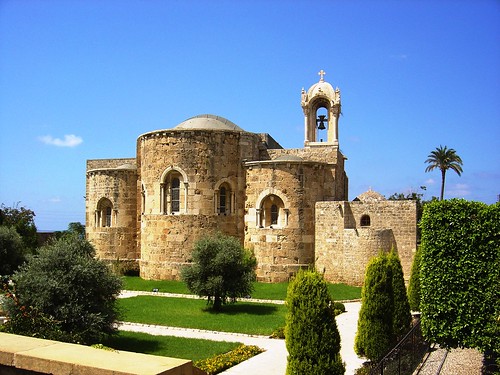
Church of St. John the Baptist in Hospital de Orbigo, Spain


Church of St. Nicholas in Portomarin Spain
From the wikipedia entry
 The Church of San Xoán (or Saint Nicholas) of Portomarín is a temple-fortress of the Order of St John of Jerusalem, in the Galician town of Portomarín, Spain.
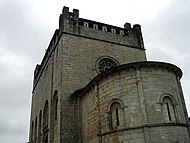
 View from the apse.
It is situated on the principal route of the Way of St. James to Santiago de Compostela, where other Templar and Knight Hospitaller churches and castles were constructed as a result of the effort of the Hospital Orders to protect the way to the tomb of Santiago; others include the churches of Torres del Río, Eunate and the Castle of Ponferrada.

Features
It is an unusual Late Romanesque temple as it is designed to be both a church and a castle and so has architectural characteristics of both buildings. As a church it has one barrel vaulted nave, a semicircular apse and all the typical decorations of Romanesque churches; these include a carved portal with archivolts, rose windows and carved capitals. As a castle its perimeter is surrounded by merlons, it has four defense towers (one at each corner) while behind it lies an adarve, a defensive street. The north west tower currently has a stork´s nest with two young (2011). The church was relocated to its current position from the valley in the 1960s when the river was flooded to form a reservoir.Strategic importance

It is situated on the principal route of the Way of St. James to Santiago de Compostela, where other Templar and Knight Hospitaller churches and castles were constructed as a result of the effort of the Hospital Orders to protect the way to the tomb of Santiago; others include the churches of Torres del Río, Eunate and the Castle of Ponferrada.
27 July 2013
Feast of St. Pantaleon
THANKSGIVING FOR THE VICTORY OF THE LIFTING OF THE SEIGE OF RHODES.
H/T to the Conventual Church of St. John of Jerusalem blog for the following,
The end of the Siege, with the Ottoman camp on the distance, and the Grand Master's army having recaptured the Tower of Italy. On this day in the year 1480, the Turks were defeated by Grand Master Pierre d'Aubusson at the lifting of the Siege of Rhodes. D'Aubusson, who was 57 at the time of the siege, was one of the most accomplished Grand Masters ever to lead the Order. A man of fine presence, a polished diplomat, a Cardinal, and as the siege was to show, a courageous leader in war.
The besieging Ottoman army was made up of 170 ships and 100,000 men, under the command of Gedik Ahmed Pasha. Grand Master d'Aubusson's small garrison was reinforced by 500 knights from France, and 2,000 soldiers under the command of the Grand Master's brother Antoine.
On this last decisive day of the battle, on which the Turks managed to capture the tower of the Langue of Italy, the battle rose to a frenzy during which 4,000 Turks were slain. The Hospitallers finally reached the tent of the Grand Vizier and captured the holy standard of Islam. Defeated, the Ottoman fleet finally left on 27th August. Safety for Christian sea traffic in the Mediterranean was thus assured, until the fall of Rhodes in 1522.
The Victory is commemorated within the Order this day in a Mass contained in a Missal of 1659 of the Domus SS Joannis et Cordulae in Cologne.
Feast of the 1st Class
ORATIO
Deus in te sperântium fortitudo, adesto precibus nostris : quas tibi cum gratiarum offerimus actione : pro Victoria Magistro nostro, ac ejus exercitui, contra hostes Fidei Christianæ Turcos, per te mirabiliter Rhodi concessa : suppliciter deprecantes: ut solitâ tuæ pietatis clementiâ muniti, dextrâque tuæ potentiæ defensi : ab hostium infidiis, omníque adversitate protegâmur. Per Dominum nostrum Jesum Christum Filium tuum. Qui tecum vivit et regnat in unitate Spiritus Sancti Deus, per omnia saecula saeculorum.
SECRETA
Hostias tibi Domine placationis et laudis offerimus, suppliciter exorantes : ut qui nos de Fidei tuæhostibus triumphare fecisti : clementer ab inimicorum infidiis, et omni periculo salves et munias. Per Dominum nostrum Jesum Christum Filium tuum. Qui vivit et regnat in unitate Spiritus Sancti Deus, per omnia saecula saeculorum.
POSTCOMMUNIO
Sumptis redemptionis nostræ muneribus, quæsumus Omnipotens Deus : eorum celebratione tuæ protectionis auxilium : et famulum tuum N. Hospitalis Hierosolomitani Magistrum, cum suo Exercitu, gratias de Triumphis Turcarum hostium fidei, nomini tuo sancto referentem : ab omni inimicorum incursu, cunctisque adversitatibus liberes semper et protegas. Per Dominum nostrum Jesum Christum Filium tuum. Qui tecum vivit et regnat in unitate Spiritus Sancti Deus, per omnia saecula saeculorum.
29 June 2013
Pope Benedict Was Interested in the Poor Also
There has been an effort by some, including well meaning Catholics, to contrast Pope Francis's concern for the poor as something not shared by his predecessor. While they may have different styles it is an unfair comparison. When one thinks of the saint who had the greatest love of the poor most will immediately think of St. Francis. Yet his contemporary St. Dominic had an equal regard for the poor and poverty but hardly anyone would think of him in the same way they do St. Francis. Below is an excerpt of an article overlooked during the pontificate of Pope Benedict but very enlightening.
BEING CHRISTIANS. FRANCIS' CHURCH CHALLENGE, BENEDICT'S CHURCH CHALLENGE
by Andrea Gagliarducci
"In the concrete history of the Church, however, a contrary tendency is also manifested, namely that the Church becomes self-satisfied, settles down in this world, becomes self-sufficient and adapts herself to the standards of the world."
Moreover: "Not infrequently, she gives greater weight to organization and institutionalization than to her vocation to openness towards God, her vocation to opening up the world towards the other."
And finally: "Once liberated from material and political burdens and privileges, the Church can reach out more effectively and in a truly Christian way to the whole world, she can be truly open to the world."
Who said this?
A first – instinctive – answer to this question would be: Pope Francis. He made "a Church of poverty and for the poor" his mark from his very first meeting with journalists. He, who has increasingly often repeated that "institutions are useful, but up to a point". He even exhorted the future Papal nuncios to “keep their inner freedom.”
The statements at the beginning of this article are actually not Francis’. They are Benedict XVI’s. The now Pope emeritus made those remarks in Freiburg, on September 25, 2011, to Catholics engaged in the life of the Church and society.
Read the rest here.
09 June 2013
Killelan Abbey - Ireland
In the R. C. divisions the parish forms part of the union or district of Castledermot. There are some slight remains of the old church, and also of an hospital formerly belonging to the Knights of St. John of Jerusalem, consisting only of a square tower in ruins.

Subscribe to:
Posts (Atom)